
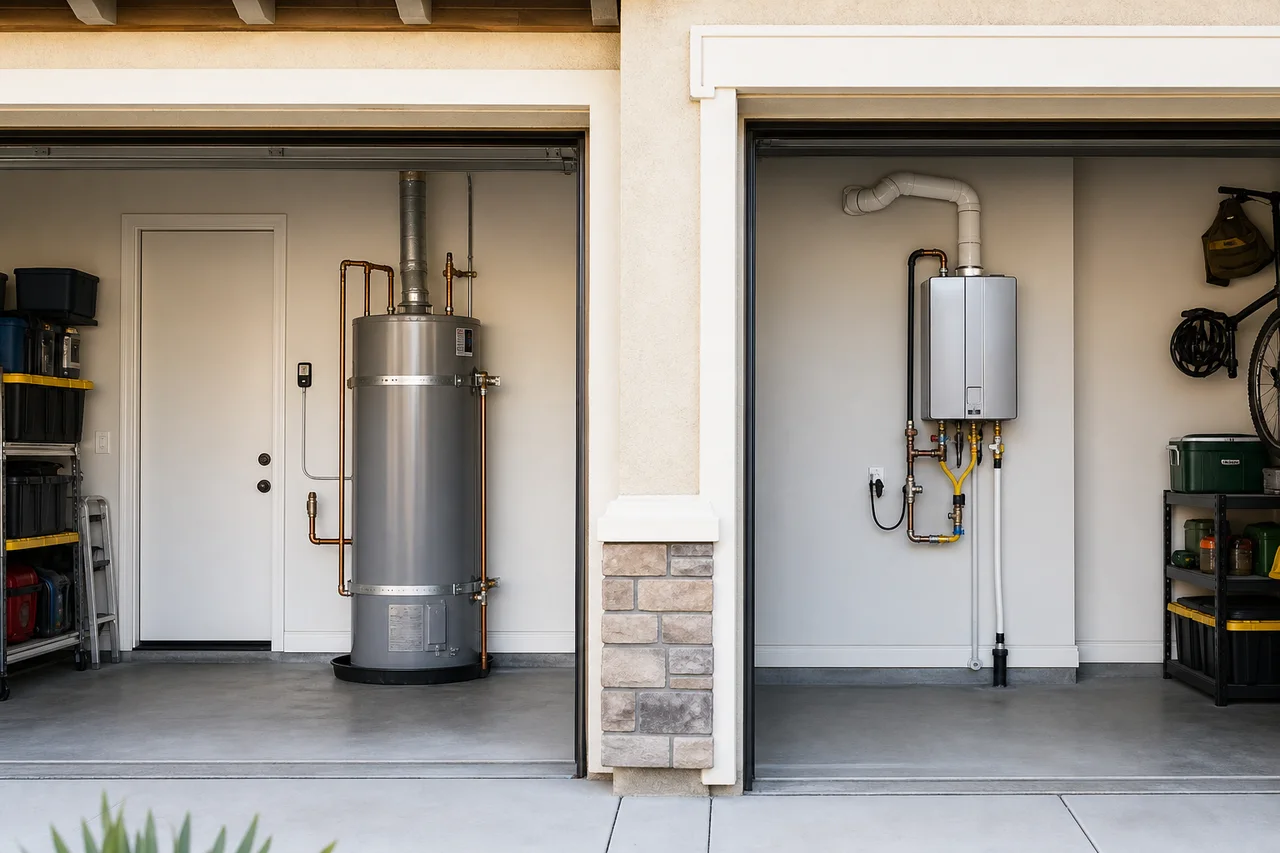
Water-heater selection begins with demand. Count simultaneous showers, fixtures, laundry, dishwashing, and any large tubs or specialty uses. A tank is sized around stored capacity and recovery; a tankless unit is sized around temperature rise and simultaneous flow. Neither label guarantees comfort if the equipment, distribution piping, fuel, or household pattern is mismatched.
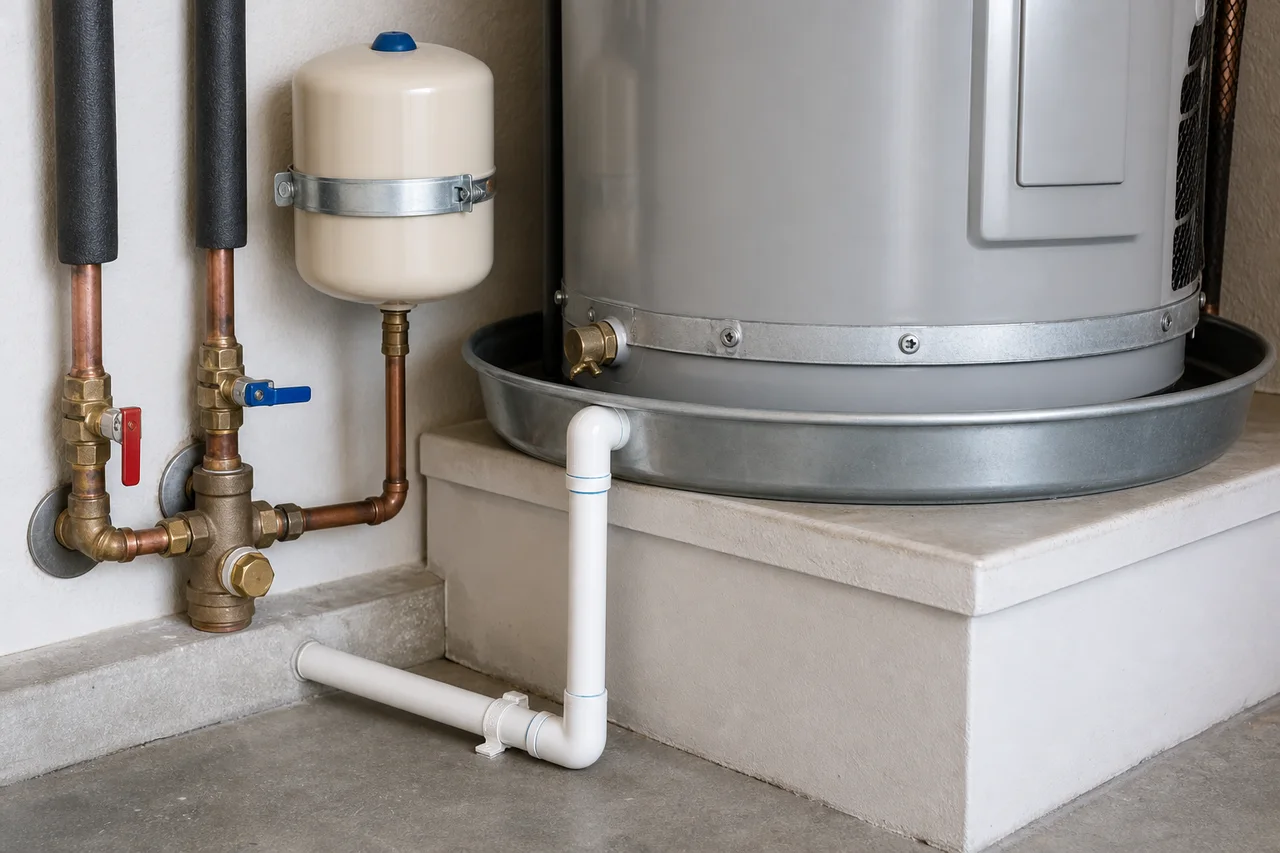
Replacement quotes should identify more than the appliance. Shutoffs, connectors, venting, combustion air, gas capacity, electrical supply, seismic restraint, drain pan, discharge piping, condensate, recirculation, permits, access, and disposal may affect scope. Existing conditions in a Vista garage can differ significantly from a closet installation in Oceanside or a commercial utility room in San Marcos.
How storage-tank systems work
A tank heats and stores a volume of water, cycling to maintain temperature. Its first-hour performance reflects storage plus recovery, so nominal gallons alone do not tell the full story. Tanks can work well for predictable demand and may align with existing connections, but exact replacement requirements still depend on fuel, venting, location, code, and the condition of surrounding components.
Standby heat loss is part of tank operation, although modern efficiency varies by model. A tank also concentrates a significant water volume in one location, making pan, drainage, seismic restraint, and leak consequences important. Do not ignore rust, moisture, unusual combustion signs, or a temperature-and-pressure relief discharge; safety devices must never be capped or defeated.
How tankless systems work
Tankless equipment heats water as flow is detected. Available output falls as required temperature rise increases, and several fixtures can exceed a unit's capacity. Very low flows may not trigger some systems as users expect. Distribution distance remains relevant: tankless does not make hot water appear instantly at a far fixture unless the overall design addresses wait time.
A retrofit may require larger gas piping, different venting, a suitable electrical circuit, condensate drainage for condensing models, wall clearances, and service access. Electric tankless equipment can have substantial electrical demand. These are design questions, not reasons to reject the technology; they are reasons to price the complete installation rather than compare appliance boxes.
Efficiency, operating cost, and household behavior
Energy labels and official efficiency information are better comparison tools than broad percentage claims. Actual cost depends on fuel rates, incoming water temperature, setpoint, hot-water volume, recirculation, pipe losses, and maintenance. A highly efficient appliance paired with wasteful distribution or excessive setpoint may not deliver the expected result.
Consider how occupants use hot water. A family with overlapping morning showers has a different demand profile from a small household with spread-out use. Rental turnover, commercial peaks, and future additions also matter. Avoid oversizing without analysis: excess capacity can increase installation cost, while undersizing can produce complaints and shorten the useful operating margin.
Maintenance and water quality
Both technologies require maintenance appropriate to the manufacturer and local conditions. Tank service may include inspection and flushing when safe and recommended; tankless units may require descaling, filter cleaning, condensate checks, and combustion service. Frequency depends on model, usage, water quality, and treatment. Follow the manual rather than a universal internet interval.
Maintenance access should influence placement. A tightly enclosed unit with no practical way to isolate, drain, or service it can increase future disruption. Preserve model and serial information, startup records, permit documents, and service history. Warranty terms are manufacturer-specific and may depend on registration, installation, maintenance, and water conditions.
A fair replacement comparison
Ask for two scopes only when both options are technically viable. Each scope should identify equipment, capacity assumptions, utility modifications, venting, drainage, permits, finish work, included accessories, exclusions, and startup. Compare lifecycle expectations without assuming a guaranteed payback. Rebates and utility programs can change, so verify them directly before purchase.
Dave's Plumbing can discuss water-heater needs for North County San Diego properties and the observed installation conditions. Provide photos, model information, fuel type, location, household demand, and any hot-water complaints. Call to confirm current service availability and whether a tank, tankless, or diagnostic assessment is appropriate for the specific property.
How this issue can differ across North County San Diego
Plumbing decisions are property-specific. Age, construction type, pressure, water use, access, prior alterations, utility responsibility, and the local permitting authority can matter more than the city name alone. The notes below are practical prompts, not assumptions about every property in a community.
Vista
Garage and exterior-wall installations still require attention to pan drainage, seismic restraint, venting, and service clearances.
San Marcos
Newer homes may have planned utility capacity, but equipment changes still require model-specific verification.
Escondido
Incoming temperature and peak household demand influence tankless sizing; do not select only by bathroom count.
Oceanside
Corrosion observations and exterior exposure should be evaluated without assuming the appliance itself has failed.
Carlsbad and Encinitas
Space-saving goals during remodels must be balanced with access, utilities, condensate, and vent routing.
Managed properties
Standardize records and replacement criteria while evaluating each unit's actual installation and demand.
A useful homeowner or property-manager checklist
Good observations shorten the path from a vague symptom to a sensible next step. Before calling Dave's Plumbing, record what you can safely observe without opening equipment, entering a hazardous area, or dismantling the system.
- Existing model, serial, fuel, and capacity
- Installation location and access route
- Number of occupants and peak simultaneous uses
- Hot-water wait and temperature complaints
- Gas, electrical, vent, and drain information
- Visible corrosion, leakage, or prior repairs
- Manufacturer maintenance and warranty records
- Permit and utility-program questions
Photos, equipment model information, prior invoices, and a simple timeline can help establish context. Do not delay a safety response to collect documentation. For active flooding, electrical exposure, a gas odor, or another immediate danger, leave the unsafe area and contact the appropriate utility or 911 from a safe location.
Build a clear service brief from those observations
A service brief is not a diagnosis and does not need technical language. Its purpose is to preserve the facts, identify constraints, and state the question that needs to be answered. Work through the prompts below using only information you can obtain safely. This creates a useful record for Dave's Plumbing, a property manager, an association, a utility, or another responsible project participant.
Existing model, serial, fuel, and capacity
Write down the observable fact in plain language. Include the room, fixture, equipment, or exterior area involved and avoid naming a cause that has not been confirmed. A precise location helps distinguish a single connection from a branch, building-wide system, neighboring unit, irrigation component, or utility responsibility.
Installation location and access route
Add the timing and pattern: when it began, whether it is constant or intermittent, and what normal use occurs immediately before it. If the symptom disappears, record that too. A repeatable trigger can guide safe testing, while an isolated event may call for monitoring or a different kind of assessment.
Number of occupants and peak simultaneous uses
Describe comparisons that can be made without dismantling anything. Note what remains normal, such as nearby fixtures, cold versus hot water, another floor, or a period with no known use. Comparisons narrow the system area and keep the service request grounded in evidence rather than a broad conclusion.
Hot-water wait and temperature complaints
Identify recent changes that may matter: utility work, remodeling, appliance installation, landscaping, tenant turnover, previous service, or a new operating schedule. A change is context, not proof of fault. Include the date and available documents so the relationship can be evaluated instead of assumed.
Gas, electrical, vent, and drain information
State access and responsibility clearly. Mention locked rooms, pets, tenant notice, association approval, roof or crawlspace restrictions, parking, cleanout access, and the person authorized to approve work. Good access information prevents a diagnosis plan from depending on an area or shutdown that is not actually available.
Visible corrosion, leakage, or prior repairs
List safety and continuity concerns before ordinary preferences. Water near electricity, ceiling movement, sewage, a gas odor, vulnerable occupants, food-service operations, or a critical business process changes the response. Do not enter an unsafe space to collect details; use the utility or emergency authority when the condition calls for it.
Manufacturer maintenance and warranty records
Attach only useful records: dated photographs, equipment labels, relevant utility history, plans, prior invoices, inspection results, and videos. Preserve original files when possible. Do not send payment information, tenant medical details, access codes, or other sensitive data in a general website request.
Permit and utility-program questions
Finish with the decision you need help making. Examples include whether an assessment is appropriate, what access should be prepared, which equipment specifications are needed, or how a planned project should be coordinated. A defined question produces a clearer conversation than asking for a price before the condition and scope are known.
Keep the brief with the property's plumbing records and update it when conditions change. If work is completed, add the final scope, provider, date, permits or inspection records when applicable, equipment information, and any follow-up instructions. That history can reveal recurrence and gives future owners or managers a more reliable starting point.
When several people are involved, use one current version rather than separate text-message threads. Mark unverified assumptions as questions, record who controls access and approvals, and confirm any utility or jurisdiction requirement directly with that authority. Clear records do not eliminate field investigation, but they reduce avoidable confusion and make later decisions easier to explain.
When a professional assessment is the better next step
Online guidance is most useful for organizing observations. It cannot show concealed pipe condition, confirm code compliance, identify the exact failure, or establish the correct repair from a distance. A professional assessment becomes more useful when symptoms recur, affect multiple fixtures, involve concealed moisture, require a shutdown, or could damage finishes, equipment, neighboring units, or business operations.
Dave's Plumbing is based in Vista and discusses residential and commercial plumbing needs across North County San Diego. Call (760) 782-5780 with the property location and requested scope to confirm current availability. The California State License Board lists Dave's Plumbing under active C-36 license #1121897; license status can be checked through the official CSLB resource below.
Authoritative resources
- U.S. Department of Energy water heaters — Official technology and consumer information.
- DOE efficient water-heater purchasing — Efficiency comparison principles.
- EPA WaterSense home maintenance — Leak and household maintenance guidance.
- CSLB license check — California contractor verification.
Important: This guide is general education. It is not a remote diagnosis, a promise that a specific service is available, an emergency-dispatch statement, or approval by a utility, manufacturer, building department, or other authority.