
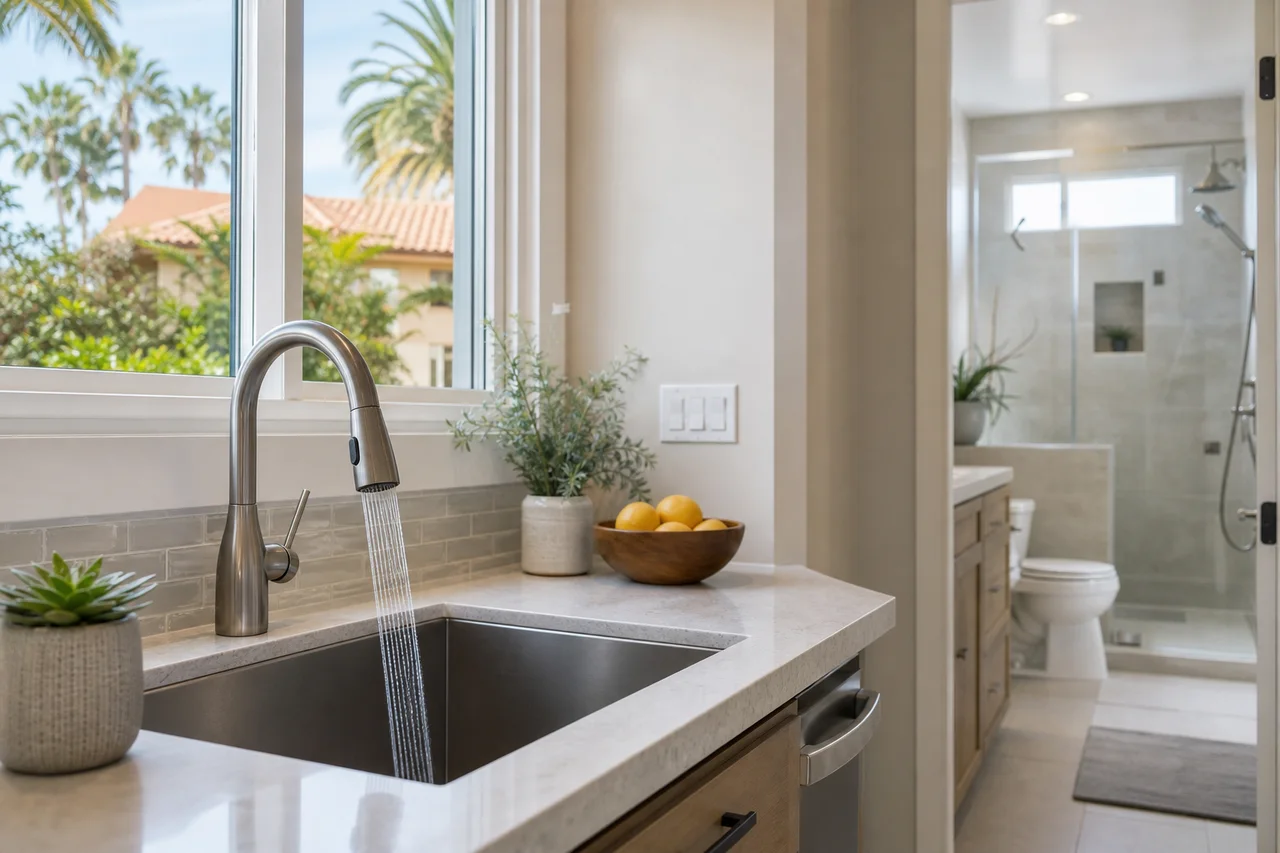
Water conservation is most useful when it preserves the experience a household actually needs. Replacing a fixture that already performs well may produce less value than fixing a silent toilet leak, correcting a dripping faucet, or reducing a long hot-water wait. Begin with bills, occupancy, fixture behavior, irrigation, and a list of recurring problems so the upgrade addresses evidence rather than a broad sales claim.
A WaterSense label indicates that an eligible product meets EPA criteria for efficiency and performance, but it does not confirm fit, mounting, rough-in dimensions, water pressure, accessibility, finish compatibility, or installation condition. Those details matter in older Vista houses, remodeled Oceanside condominiums, San Marcos rentals, and Escondido properties with a mix of original and replacement fixtures.
Start by finding avoidable water use
Review several utility bills and note changes in occupants, irrigation, guests, pool use, or appliance schedules. Walk the property for dripping faucets, toilets that refill between uses, moisture beneath sinks, and exterior connections that leak after shutoff. A confirmed leak is a better first project than replacing unrelated fixtures because the symptom, location, and result can be observed.
Use a meter only according to the water provider's instructions and only when it is safely accessible. A reading during a no-use period may show that water is moving, but it cannot identify the source. Automatic equipment and shared plumbing can complicate the result. Record the time and operating conditions before moving to diagnosis.
Evaluate WaterSense fixtures beyond the label
For toilets, verify rough-in distance, bowl shape, seat height, clearance, flange condition, supply location, and user preference. For showerheads and faucet accessories, compare rated flow, pressure behavior, spray pattern, and compatibility. The EPA maintains product information and labeled-product resources; use current listings rather than an old model recommendation in a contractor article.
Lower flow does not correct mineral restriction, undersized piping, a partly closed valve, pressure problems, or a failing fixture. Establish how the existing fixture behaves first. In multiunit properties, confirm whether a building pressure system, common hot-water system, or association rule affects selection. Keep model numbers so replacement parts and performance can be reviewed later.
Treat hot-water wait time as a system question
Water may run down the drain while occupants wait for hot water to travel from the heater. The practical response depends on pipe length and routing, insulation, household schedule, equipment, energy source, temperature control, and local rules. A recirculation system can change both water and energy use; point-of-use equipment introduces electrical, space, drain, and maintenance questions.
Before selecting a solution, time the wait at representative fixtures and note simultaneous demand. Compare kitchen, primary bath, and remote fixtures at similar times of day. Do not raise storage temperature or modify safety controls based on an online tip. Scald risk, equipment instructions, code requirements, and distribution design require project-specific consideration.
Plan installation conditions before buying fixtures
Accessible shutoffs, flexible connections, supply piping, drain alignment, flange condition, mounting surfaces, waterproofing edges, and cabinet clearances can change a simple-looking replacement. An old valve may not isolate reliably; a toilet flange may need evaluation after removal; a faucet may require access that finished cabinetry blocks. A pre-purchase review reduces the chance of choosing an incompatible product.
Ask what the quoted scope includes: removal, disposal, new connectors, valves, mounting repairs, permit or inspection responsibilities when applicable, finish work, and testing. Plumbing work does not automatically include tile, cabinetry, electrical work, restoration, or manufacturer warranty administration. Clear scope is especially important for rentals and occupied remodels where access windows are limited.
Verify incentives and judge results honestly
Rebates, qualifying models, purchase dates, installation rules, funding, and service-area eligibility change. Check the current water district or regional program before purchase and save the product documentation. Dave's Plumbing does not control rebate approval. A product that conserves water can still be a poor choice if it does not fit, perform for the occupants, or receive required maintenance.
After installation, check for leaks, stable mounting, normal drainage, comfortable use, and expected hot-water behavior. Compare bills over meaningful periods while accounting for occupancy and seasonal demand. Dave's Plumbing can discuss fixture and residential plumbing work for North County San Diego properties, subject to service availability and the actual conditions at the address.
How this issue can differ across North County San Diego
Plumbing decisions are property-specific. Age, construction type, pressure, water use, access, prior alterations, utility responsibility, and the local permitting authority can matter more than the city name alone. The notes below are practical prompts, not assumptions about every property in a community.
Vista
Check the current Vista Irrigation District program and property eligibility before treating a rebate as part of the budget.
San Marcos
Confirm common-system and association responsibilities before changing fixtures or hot-water circulation in attached housing.
Escondido
Separate indoor use from irrigation and seasonal outdoor demand when comparing bills or meter observations.
Oceanside
Remodel history and exposed connection corrosion can affect the installation scope even when the selected fixture is efficient.
Carlsbad and Encinitas
Record existing model numbers and rough-ins in high-finish bathrooms before ordering replacement fixtures.
Property managers
Standardize approved models only after confirming fit, parts availability, occupant needs, and building pressure conditions.
A useful homeowner or property-manager checklist
Good observations shorten the path from a vague symptom to a sensible next step. Before calling Dave's Plumbing, record what you can safely observe without opening equipment, entering a hazardous area, or dismantling the system.
- Several recent water bills and occupancy changes
- Known leaks or fixtures that refill or drip
- Current fixture model and rough-in dimensions
- Pressure or flow complaints at other fixtures
- Timed hot-water wait at representative locations
- Shutoff, cabinet, and mounting access
- Current rebate terms from the official provider
- Desired result and post-installation measurement
Photos, equipment model information, prior invoices, and a simple timeline can help establish context. Do not delay a safety response to collect documentation. For active flooding, electrical exposure, a gas odor, or another immediate danger, leave the unsafe area and contact the appropriate utility or 911 from a safe location.
Build a clear service brief from those observations
A service brief is not a diagnosis and does not need technical language. Its purpose is to preserve the facts, identify constraints, and state the question that needs to be answered. Work through the prompts below using only information you can obtain safely. This creates a useful record for Dave's Plumbing, a property manager, an association, a utility, or another responsible project participant.
Several recent water bills and occupancy changes
Write down the observable fact in plain language. Include the room, fixture, equipment, or exterior area involved and avoid naming a cause that has not been confirmed. A precise location helps distinguish a single connection from a branch, building-wide system, neighboring unit, irrigation component, or utility responsibility.
Known leaks or fixtures that refill or drip
Add the timing and pattern: when it began, whether it is constant or intermittent, and what normal use occurs immediately before it. If the symptom disappears, record that too. A repeatable trigger can guide safe testing, while an isolated event may call for monitoring or a different kind of assessment.
Current fixture model and rough-in dimensions
Describe comparisons that can be made without dismantling anything. Note what remains normal, such as nearby fixtures, cold versus hot water, another floor, or a period with no known use. Comparisons narrow the system area and keep the service request grounded in evidence rather than a broad conclusion.
Pressure or flow complaints at other fixtures
Identify recent changes that may matter: utility work, remodeling, appliance installation, landscaping, tenant turnover, previous service, or a new operating schedule. A change is context, not proof of fault. Include the date and available documents so the relationship can be evaluated instead of assumed.
Timed hot-water wait at representative locations
State access and responsibility clearly. Mention locked rooms, pets, tenant notice, association approval, roof or crawlspace restrictions, parking, cleanout access, and the person authorized to approve work. Good access information prevents a diagnosis plan from depending on an area or shutdown that is not actually available.
Shutoff, cabinet, and mounting access
List safety and continuity concerns before ordinary preferences. Water near electricity, ceiling movement, sewage, a gas odor, vulnerable occupants, food-service operations, or a critical business process changes the response. Do not enter an unsafe space to collect details; use the utility or emergency authority when the condition calls for it.
Current rebate terms from the official provider
Attach only useful records: dated photographs, equipment labels, relevant utility history, plans, prior invoices, inspection results, and videos. Preserve original files when possible. Do not send payment information, tenant medical details, access codes, or other sensitive data in a general website request.
Desired result and post-installation measurement
Finish with the decision you need help making. Examples include whether an assessment is appropriate, what access should be prepared, which equipment specifications are needed, or how a planned project should be coordinated. A defined question produces a clearer conversation than asking for a price before the condition and scope are known.
Keep the brief with the property's plumbing records and update it when conditions change. If work is completed, add the final scope, provider, date, permits or inspection records when applicable, equipment information, and any follow-up instructions. That history can reveal recurrence and gives future owners or managers a more reliable starting point.
When several people are involved, use one current version rather than separate text-message threads. Mark unverified assumptions as questions, record who controls access and approvals, and confirm any utility or jurisdiction requirement directly with that authority. Clear records do not eliminate field investigation, but they reduce avoidable confusion and make later decisions easier to explain.
When a professional assessment is the better next step
Online guidance is most useful for organizing observations. It cannot show concealed pipe condition, confirm code compliance, identify the exact failure, or establish the correct repair from a distance. A professional assessment becomes more useful when symptoms recur, affect multiple fixtures, involve concealed moisture, require a shutdown, or could damage finishes, equipment, neighboring units, or business operations.
Dave's Plumbing is based in Vista and discusses residential and commercial plumbing needs across North County San Diego. Call (760) 782-5780 with the property location and requested scope to confirm current availability. The California State License Board lists Dave's Plumbing under active C-36 license #1121897; license status can be checked through the official CSLB resource below.
Authoritative resources
- EPA WaterSense overview — How the federal efficiency program works.
- EPA WaterSense label — Official label and performance criteria information.
- EPA WaterSense residential toilets — Toilet efficiency and labeled-product guidance.
- Vista Irrigation District device rebates — Current local program entry point; eligibility and funding can change.
Important: This guide is general education. It is not a remote diagnosis, a promise that a specific service is available, an emergency-dispatch statement, or approval by a utility, manufacturer, building department, or other authority.